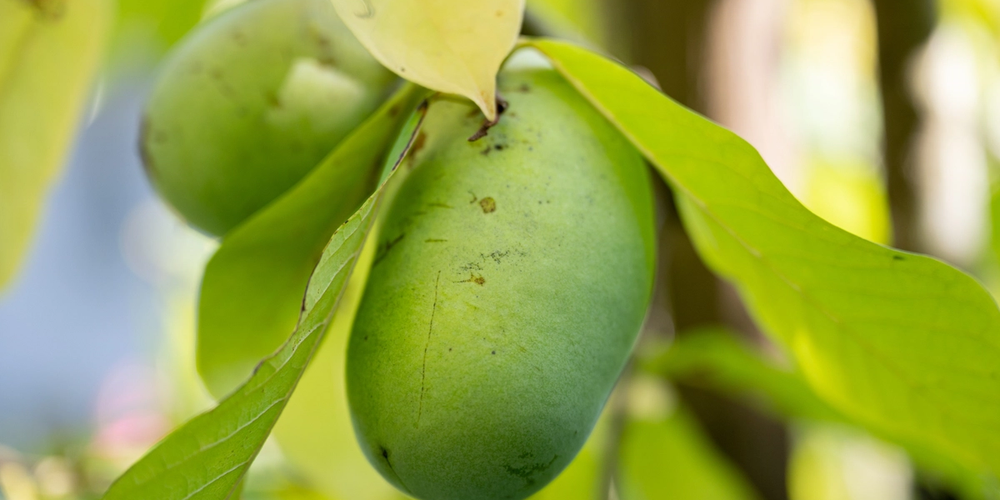
Growing a Pawpaw Tree Way Down Yonder in a Greenhouse

- Family: Annonaceae
- Scientific Name: Asimina triloba
- Common Name: Pawpaw, Common Pawpaw, American Pawpaw
- Type: Perennial tree
- Light: Full to partial sun; shade protects from harsh afternoon sun
- Soil pH: Slightly acidic to neutral
- Soil: Moist, well-draining
- Zone: 5–9 (USDA) (Can be extended in a dome greenhouse)
Growing Pawpaw Trees
In the wild, pawpaws typically grow as understory trees in moist forests, often forming thickets. They do fine with five hours of sunlight per day and thrive in partial shade. Growing one tree will give you flowers, but if you want fruit, two genetically different trees are necessary for pollination. Pawpaw trees require patience. Seed-grown trees may take five to eight years to begin producing fruit, while grafted trees can bear much sooner.
Pawpaw trees are deciduous, losing leaves in the winter. In a Growing Dome greenhouse, they provide needed shade in the summer and allow ample solar gain in winter.
Free Download
What is the Best Place to Plant Pawpaw Trees?
A seedling or young tree (under two years old) is best planted in partial shade as they are very sensitive to heat. We recommend planting a pawpaw tree on the east side of the dome to avoid the afternoon sun. A shade cloth may be helpful to protect young trees.
At Growing Spaces, we are conducting an experiment and have planted two Pawpaw trees. We planted one on the southeast side and one on the southwest side to provide the best shade structure for the other plants in our greenhouse. We do have a shade cloth in place while the trees get established. We are going into year 3, and our trees were a few feet tall when we received them. We will report back if the one on the east does better, worse, or the same as the west.

Planting Pawpaw Trees
If you are a very, very, very patient gardener, you can try growing a pawpaw tree from seed, but it requires both a cold and moist stratification period of 90-120 days. And that is followed by a very long germination period of three weeks to three months. Our recommendation is to buy a tree instead!
Pawpaws are unusually sensitive to transplanting. Spring, around the time new growth begins, is generally the best time to transplant. Choose a permanent location for the tree. Prepare the ground before removing the tree from the container. A good rule of thumb is to dig a hole slightly wider than the root ball and deep enough for the tree to sit at its existing soil level.
Once the hole is ready, gently remove the tree from the pot, being careful with the roots. Pawpaw roots are fragile. The hole should be deep enough that the taproot is straight and not curled or bent.
How Should You Care for Pawpaw Trees?
Light: Partial shade for young trees; full sun to light shade once established. Young seedlings benefit from partial shade for their first year or two, but mature pawpaws generally produce the most fruit in full sun. Heavy shade can substantially reduce fruit production.
Temperature: Pawpaw trees are native to the eastern United States and can tolerate temperature fluctuations in zones 5-9.
Soil: Pawpaw trees are an understory plant, so they like moist, well-draining soil that is slightly acidic. When choosing the location for your trees, consider the watering requirements of nearby plants.
Water: Soil that is uniformly moist is perfect for pawpaw trees. Water the soil deeply once a week, especially with young trees, as this will help them grow strong, well-established roots.

Pollination: Two genetically different trees are needed for pollination and fruit formation. A single tree will only produce flowers and no fruit. Pawpaw flowers smell like rotting meat because they are primarily pollinated by flies and beetles. Gardeners growing them in a greenhouse may need to hand-pollinate flowers if natural pollinator activity is limited.
Pruning: Prune pawpaw trees when they are dormant in the winter or early spring. A good rule of thumb is to never prune more than ⅓ of the tree. Focus on trimming lower branches or suckers; remove any diseased or broken branches as well as any branches that cross each other.

What are the Best Companion Plants For Pawpaw Trees?
As a woodland tree, it’s best to consider the needs of a pawpaw tree and match it with plants that fit that characteristic. Pawpaw companion plants need to tolerate partial shade, are not competitive with the tree’s roots, and should be woodland-friendly. Avoid planting thirsty plants close to the trees. Consider some understory plants such as American Elderberry or Zigzag Goldenrod.

Managing Pests and Diseases
While pawpaw trees are fairly hardy and typically disease-resistant and pest-resistant, we recommend that gardeners keep a close eye on the crops.
Powdery mildew can affect pawpaw trees, so watering the soil is better than drenching the tree leaves with a hose.

Keep an eye out for the speckled talponia moth, aka pawpaw peduncle borer. It eats the flowers, which will affect fruit production.
The larvae of Zebra Swallowtail butterflies do feed on the leaves of pawpaw trees, but cause minimal damage.
Of course, there are the usual suspects that enjoy pawpaw fruit. Birds, foxes, opossums, raccoons, and squirrels will help themselves to the fruit if they can get to it. Another benefit to a Growing Dome Greenhouse is that your crops are protected from critters!
Harvesting Pawpaw Fruit
Seed-grown pawpaws typically begin producing in roughly 4–8 years, while grafted trees may flower and fruit in as little as 2–3 years. Fruit ripens in mid to late summer in the southern climates and in the fall in northern climates.
The oblong fruit grows to about six inches in length and is soft and easy to bruise. Pawpaw fruit is ripe when it is soft to the touch and easy to pick from the tree.

Some compare the taste to something between a banana and mango with a custard-like texture.
NOTE: Eat only the soft fruit pulp. The skin and seeds are not considered edible and should be discarded.
The History of Pawpaw Trees
Pawpaw trees are native to North America, and they are the largest edible indigenous fruit on the continent!
Many Native American tribes cultivated pawpaw trees along the East Coast as well as in the Midwest. Algonquin, Sioux, Iroquois, Cheyenne, Shawnee, and Osage are just a few of the tribes recorded to have utilized pawpaw fruit and other parts of the tree. The bark was used to make ropes and string, the fruit was mashed into dried cakes, and the Shawnee had a “pawpaw” month on their calendar.
The first time Europeans mentioned pawpaw was in 1541. Spanish conquistador Hernando de Soto was in the Mississippi Valley when he observed Native Americans growing and eating the fruit. One theory is that the name pawpaw was misidentified as papaya, hence the name.
Pawpaw Trivia
- The word “pawpaw” may have come from early European explorers who confused papayas with pawpaw. The Latin name, Asimina triloba is thought to come from the Algonquin word “assimin” which is connected to pawpaws.
- Way Down Yonder in the Pawpaw Patch is a children’s circle game. Did you ever sing it as a child?
- Did you know that chilled pawpaw fruit was a favorite dessert of George Washington?
- Not surprisingly the pawpaw was another tree Thomas Jefferson planted at his home in Virginia.
- The Lewis and Clark Expedition occasionally ate pawpaws during their travels and Daniel Boone was also a fan of the pawpaw.
- Did you know that September is pawpaw season!
Pawpaw Nutrition
Pawpaw fruit is another low-fat fruit that is similar in calories and fiber to a banana. While you can’t find it in a grocery store, you can grow it in your garden or greenhouse!

Pawpaw fruit provides vitamin C, magnesium, iron, copper, manganese, potassium and several other nutrients. Like many foods, pawpaw may cause digestive discomfort or an allergic reaction in some people, so enjoy this unusual fruit in moderation.
Frequently Asked Questions
What are the ideal growing conditions for pawpaw trees?
Young pawpaw trees benefit from partial shade, while established trees produce the most fruit in full sun. They prefer moist, well-drained, slightly acidic soil and generally grow in USDA Zones 5–9.
How long does it take for a pawpaw tree to bear fruit?
Seed-grown pawpaws generally begin flowering and fruiting in about 4–8 years, while grafted trees may begin producing in as little as 2–3 years.
When is the best time to prune my pawpaw trees?
The best time to prune pawpaw trees is in winter or early spring before new growth starts. Prune any diseased or broken limbs as well as suckers and limbs that cross each other. It is best to only prune up to a third of the plant.
Where do pawpaw trees grow?
Pawpaw trees grow wild in 25 states in the mid-Atlantic area, the southern area and the Midwest.
Why can’t you buy pawpaw fruit in the stores?
Pawpaw fruit has a very short shelf life and bruises easily, making it difficult to ship and distribute commercially. That is why it is much more commonly found at farmers markets, local growers or in home gardens than in conventional grocery stores.

Seasonal Growing Tips & Greenhouse Advice
Monthly stories from our greenhouses, Growing Dome spotlights, and other gardening content


Share This

I joined Growing Spaces in 2021 as a gardener and now work with the Marketing and Social Media department. Formerly I was a kindergarten teacher and then worked as a Gardener and Volunteer Coordinator at Maui Nui Botanical Gardens in Hawai'i. Since moving to Colorado I have worked in the veterinary field and have been involved in therapy dog work visiting hospitals, schools and libraries with a national therapy group. My previous dog and I also worked as a crisis response team helping those affected by crises or disasters and were deployed through Hope Animal-Assisted Crisis Response (Hope AACR). Muppet and Maple are my current therapy dogs and we visit the library and hospital here in Pagosa Springs. Muppet is also a crisis response canine with Hope AACR. Outside of working and volunteering, I love growing native plants, flowers, berries, herbs and veggies at home, photography, hiking, horseback with my husband and hanging out with our dogs.
View full bioDownloads
Featured Categories
Seasonal Growing Tips & Greenhouse Advice
Monthly stories from our greenhouses, Growing Dome spotlights, and other gardening content
Featured Stories

How to Grow Fruit Trees in a Greenhouse

A One of a Kind Dome in Nunn, Colorado


Powdery Mildew and Fungal Infections


Featured Products


Sign up for The Happy Grower Newsletter
Once a month: stories from our gardens, Growing Dome spotlights, and what's in season in Pagosa Springs.