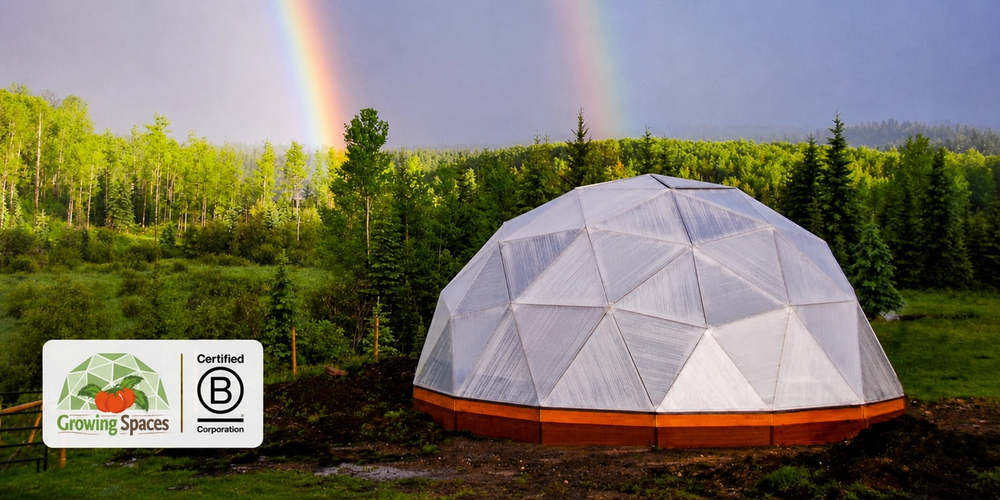
Growing Spaces is now a Certified B Corporation

Growing Spaces is now a Certified B Corporation™.
B Corp certification reviews a company’s social and environmental performance, transparency, and accountability through a detailed assessment, supporting documentation, and review by B Lab™. For us, that meant spending months gathering evidence for claims and practices we had discussed for years.
We certified under B Lab’s V1.6 standards with a score of 82.2, above the qualifying threshold of 80. For context, our public profile lists a median score of 50.9 for businesses completing that assessment.
Getting there took a substantial effort across our team, especially for a 20-person manufacturer in rural Colorado.
Learn more about B Corp Certification at bcorporation.net
What the process forced us to prove
Working through the assessment meant looking closely at what we could document and where our records or practices needed work. Our energy claims were one example.
We’ve been building passive-solar geodesic greenhouses since 1989 for customers in cold, high-altitude, and arid climates, as well as people growing off-grid. In each of those settings, the energy required to operate a greenhouse is an important part of whether it makes sense.
That is why we have talked for years about how the Growing Dome’s passive systems reduce the energy needed for heating and cooling. The assessment pushed us to describe the comparison more precisely and document the assumptions behind it.
Our earlier operational energy model covered all six Growing Dome sizes and six climate zones, comparing fully mechanical heating and cooling with strategies that used passive ventilation, the pond, and solar-powered fans in the same dome. Under those assumptions, the passive-plus-pond strategy used roughly 30 to 40 percent as much grid electricity as the fully mechanical baseline.
The operating temperature and equipment assumptions become especially important in a sub-arctic climate, where supplemental heat can account for a substantial share of annual energy use.
Because actual energy use depends on the site, crops, operating temperatures, and supplemental equipment, those results need to be read with their assumptions in mind. We have since revised the methodology, but the work gave us a documented way to examine the energy claim and show how we arrived at the comparison.
Beyond the product’s energy use, the review made us look at how we run the company.
We examined employee practices, workplace safety, benefits, customer support, community impact, and governance. Some of that work confirmed things we already do well, such as having staff who know the product and making sure customers can still reach a person. As we went further, though, we also found areas that needed closer attention, particularly how we record decisions and apply our policies.
In several categories, we lost points because we could not document things we were doing in practice. In others, the practices themselves needed work, so better records alone would not close the gap.
Those findings matter to a customer buying a greenhouse meant to last for decades. If they are going to rely on us for parts and support, we need to price products, train employees, and keep records in ways that allow us to sustain that service.
With that in mind, we have been standardizing customer agreements, clarifying warranty and installation practices, and giving our team clearer authority to resolve customer problems. Better documentation is part of that effort because it helps people apply those decisions consistently.
Some of the findings were uncomfortable, but I would rather know where we are falling short and have specific work to do than assume that good intentions are enough.
What changes, and what doesn’t
The product continues to use the same basic approach: Growing Domes collect solar energy and store some of that heat in water and soil, while insulation slows heat loss and vents and fans help manage air exchange and circulation. Owners add supplemental equipment according to their climate and growing goals, and repairability and maintenance remain part of how we design and support the structures.
Two things do change:
First, certification formalizes our commitment to consider employees, customers, the community, suppliers, and the environment in business decisions. Growing Spaces has considered those responsibilities for a long time, and we now have an external standard against which to assess the work.
Second, keeping the certification requires further review, which means continuing to document our practices and address the gaps identified in this assessment. B Lab is also transitioning to new standards, so our next assessment will depend on the applicable requirements.
Thank you
Thank you to the employees who gathered records and answered questions while keeping the business running through the assessment. Much of what we were able to document began with the company’s founders and previous owners, and our customers, installation crews, and suppliers have helped us understand where we still need to improve.
I want customers to be able to trust our advice and employees to know what to expect from us. Having a more specific basis for judging how well we are doing helps me see where those expectations are being met and where we have more work to do.
-Gary

Seasonal Growing Tips & Greenhouse Advice
Monthly stories from our greenhouses, Growing Dome spotlights, and other gardening content


Share This

Gary Hall owns and runs Growing Spaces, the Pagosa Springs, Colorado manufacturer that has designed and built geodesic Growing Dome greenhouses for 35+ years, with more than 2,000 installations across 50 states and 14 countries. His daily work puts him inside domes and on install sites: he tours the six domes on the company's campus, walks the production floor, works with customers on climate-specific configuration, and talks through long-term operation with owners who have lived with the product for decades. Gary writes from that first-hand vantage about passive-solar greenhouse design, the engineering of geodesic domes (including 115 mph wind and 120psf snow load ratings), polycarbonate glazing, thermal mass and above-ground pond systems, undersoil heat exchange, ventilation, and the realities of siting, installing, and operating a dome through its 30+ year service life. He also writes about year-round greenhouse gardening and how to adapt growing practices to a semi-controlled environment. Gary acquired Growing Spaces in April 2025. He works closely with original founder Udgar and previous owner Lem Tingley, and considers himself the current shepherd of a 35+ year product legacy. He holds the CFA charter and an undergraduate degree in the hard sciences from Oregon State University.
View full bioFeatured Categories
Seasonal Growing Tips & Greenhouse Advice
Monthly stories from our greenhouses, Growing Dome spotlights, and other gardening content
Featured Stories


5 Charities Fighting Food Insecurity


Featured Products


Sign up for The Happy Grower Newsletter
Once a month: stories from our gardens, Growing Dome spotlights, and what's in season in Pagosa Springs.