Why We Built the Growzebo™

When I first brought up the idea of another greenhouse, I had two things in mind: a price target and a customer we miss out on.
I was thinking about someone who likes what Growing Spaces builds but is not going to buy a Growing Dome. For some people, even a 15- or 18-foot Dome is more greenhouse than they need. For others, it is simply more than they want or can afford to spend.
I wanted us to have a real answer for that person, but that was about as far as my brief went. Rather than give the team a shape or a drawing, I left them to work through the structure, the prototype, the way the kit would go together, and the interior options.
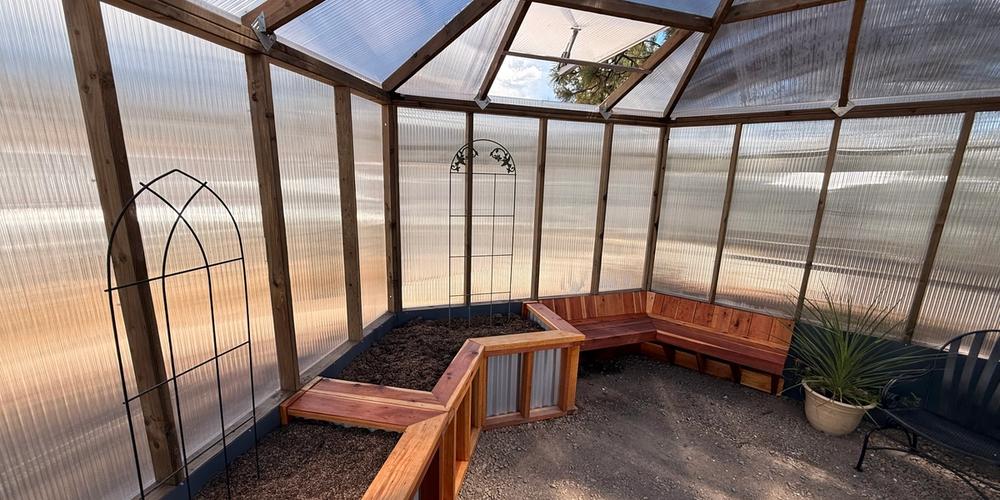
What they built became the Growzebo™, a three-season, walk-in greenhouse with about 167 square feet inside.
We built it beside the Domes
The first Growzebo went up on our campus in Pagosa Springs, about 20 yards from all six of our demonstration Growing Domes®, so the team had full-size examples to compare throughout the build.
At any point, they could walk out of the new structure and into a 15-foot Dome, then a 26-foot Dome, then a 42-foot Dome to compare the light, wall height, door placement, and growing room. They could also see how beds and paths shaped each interior. The Domes we use for tours and education became a useful reference while they worked through the new design.

Working on the same three-acre campus, close to production and the demonstration gardens, made it easy for people across the company to contribute. Someone on the production floor could spot a connection that looked fine on paper but would be awkward to build, while our advisors knew which details were likely to prompt questions before or after delivery. Marketing, finance, and HR participated too. Once the first frame was up, everyone could judge the wall space, door swing, roof height, and ventilation layout at full scale.
I was proud to see how much they could work out together from a fairly open brief, taking responsibility for the project from beginning to end.
Why the hexagon won
We considered several shapes, but once we saw the hexagonal version, it was the one we kept returning to. The straight sides worked well for beds and benches while leaving the center open, and the roofline gave the interior more height without making the walls hard to use.
It is also hard to spend that much time looking at hexagons without thinking about honeycomb. Once we noticed the resemblance, we liked the shape even more. Honey bees seem like appropriate company for a greenhouse.
When it came to the name, we wanted to keep the “Grow” connection with the Growing Dome. The six-sided footprint and open center reminded us of a garden gazebo, so Growzebo followed pretty quickly.
How we kept the price down
Reaching the lower price meant narrowing the structural requirements, with snow being the clearest tradeoff. The current design has been evaluated for a maximum ground snow load of 25 psf, so it is not intended for deep-snow sites. That lower requirement helped us reach the price target, although local snow, wind, foundation, and permitting requirements still need to be checked before ordering.
Within that lighter-duty design, we kept the same 16 mm, five-wall polycarbonate glazing used on our Growing Domes. The 24-inch foundation wall is designed for rigid foam insulation, which the owner supplies locally.
We also paid attention to warm days in the cool and mild climates we had in mind, so the standard kit includes an automatic upper vent and a storm door with an opening screened window. For additional ventilation, owners can add a 12-inch solar-powered wall fan, a second (or even third) automatic upper vent, or both.

We left out the Growing Dome’s geodesic frame, reflective north-wall insulation, above-ground pond, and undersoil air circulation. Leaving those features out reduced cost, but it also changed the range of conditions the greenhouse was designed to serve.
That difference matters if someone plans to heat it through winter. Adding a heater would not provide the pond or reflective north wall that help a Dome use winter sun, so for a comparable growing area and indoor temperature, I would plan on more active heating in the Growzebo. The lower purchase price needs to be weighed alongside that operating cost.
Who I think the Growzebo™ is for
Those tradeoffs are why I think the best locations will be places with relatively mild winters and long, chilly spring and fall seasons. Many low-elevation communities along the Pacific Coast fit that description, as do milder, lower-snow coastal areas in the Mid-Atlantic and Southeast.
In those places, a gardener may want room to start seedlings, protect plants from rain and wind, keep harvesting later into fall, overwinter plants, and work inside without needing a full winter climate system. A cold frame can cover a smaller growing area close to the ground, but someone who wants to walk inside needs more room. The Growzebo provides space for beds, benches, containers, and a place to sit.
For homeowners, homesteaders, schools, and community gardens looking for a four-season solution, I still think the Growing Dome is our best fit. Professional nurseries generally plan around commercial greenhouse systems with active heating and cooling, which puts them in a different market.
I would also steer someone toward a properly configured Dome for deep snow, frequent hard freezes, or a northern or high-elevation site with serious winter weather, even if they only plan to grow from spring through fall.
The team took a price target and a rough description of the customer through to a finished prototype, making the design choices along the way. Having watched that happen, I am proud to put the Growzebo alongside the six Domes they used as a reference.
Explore the Growzebo™ greenhouse kit.
-Gary

Seasonal Growing Tips & Greenhouse Advice
Monthly stories from our greenhouses, Growing Dome spotlights, and other gardening content


Share This

Gary Hall owns and runs Growing Spaces in Pagosa Springs, Colorado. He acquired the company in April 2025 and works closely with founder Udgar Parsons, previous owner Lem Tingley, the Growing Spaces team, and Dome owners. His articles draw on operating the business, helping customers plan their greenhouses, and learning from owners’ experiences. Gary holds the CFA charter and an undergraduate degree from Oregon State University.
View full bioFeatured Categories
Seasonal Growing Tips & Greenhouse Advice
Monthly stories from our greenhouses, Growing Dome spotlights, and other gardening content
Featured Stories
Featured Products


Sign up for The Happy Grower Newsletter
Once a month: stories from our gardens, Growing Dome spotlights, and what's in season in Pagosa Springs.