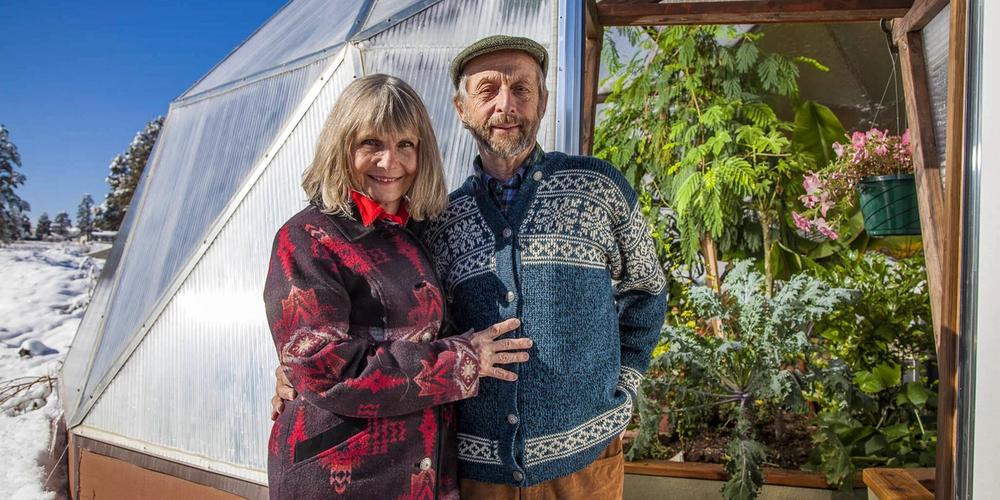
How Winter Growing is Possible

The difference between the inside and outside of the dome on a cold winter night depends on how many sunny days you are having. With the domes 7 unique features for heating and cooling, we are able to grow year-round, even in the Rocky Mountains, because we can keep the temperature at a decent level from the dome’s unique design. Here’s a synopsis of the 7 features:
1. The dome’s 5 layer, 16mm glazing provides insulation for the dome, and stability for the snow mass. 2. The undersoil heating/cooling fan blows air through the soil year-round to keep the soil temperature at a moderate range. 3. The automatic vents in the top of the dome will open if the heat becomes too much during the summer, allowing the dome to cool using a chimney effect. On our larger domes (26′ and larger, optional on smaller domes), the cooling fan(s) that are mounted on the side of the dome have automatic shutters that open at the right temperature, as well as a thermostat on the fan to cool the dome in summer if needed. 4. The perimeter insulation that is placed around the outside wall of the dome where the dome meets the soil prevents frost from penetrating under the wall of the dome. 5. The insulation in the wall of the dome has an R value of R12 which insulates the dome and the soil from frost. 6. The north wall insulation has an R10 value, and provides insulation and reflection of the sun’s light into the water tank. 7. The water tank, which absorbs the heat from the sun during the day, and emits it at night, acts as a heat mass to help bring the temperature up at night.
This winter we have had temperatures colder than -20 degrees Fahrenheit, and our plants were just fine inside the dome even though they frozen a little. As for temperature range, on a sunny day during the winter, storing heat in the water tank and the soil from the sun allows for there to be an average temperature difference of 30 degrees warmer than what is outside. However, if you’ve had lots of cloudy days and it gets cold, the dome doesn’t have the stored heat built up, and will not perform as well. The difference is only 20 degrees in this case on average. There’s always a temperature gradient within the dome itself, meaning you will have different temperatures inside the dome as well. If the temperature outside for example is around 5 below, the temperature in the outside bed might be 25 degrees, but the temperature of the bed near the water tank might be 35 or 40 degrees. So, you should take this into account when placing crops for winter growth. The crops near the water tank will grow faster in cold conditions than the ones on the south side due to this.

Seasonal Growing Tips & Greenhouse Advice
Monthly stories from our greenhouses, Growing Dome spotlights, and other gardening content


Share This

This byline marks posts written collectively by Growing Spaces staff where no single contributor is the primary author. Growing Spaces has designed and built geodesic Growing Dome greenhouses from Pagosa Springs, Colorado since 1989, with more than 2,000 installations across 50 states and 14 countries. Posts under this byline draw on shared expertise from the team: gardeners working the production trial domes, design and engineering staff, installation crews working on customer sites, and customer experience staff who walk owners through configuration and long-term operation. When a post belongs under one person's name, it carries that person's byline instead.
View full bioDownloads
Featured Categories
Seasonal Growing Tips & Greenhouse Advice
Monthly stories from our greenhouses, Growing Dome spotlights, and other gardening content
Featured Stories


Managing Winter Humidity in a Greenhouse


Featured Products


Sign up for The Happy Grower Newsletter
Once a month: stories from our gardens, Growing Dome spotlights, and what's in season in Pagosa Springs.